


The Implications of Regulation (EU) 2023/1230
The modernization of industrial equipment already in service (retrofit) and the integration of robotic cells are common strategies for increasing throughput, repeatability, flexibility, and process safety while extending the service life of existing equipment. In this article, we will examine when a retrofit becomes a substantial modification.
However, there is a critical boundary that engineering teams do not always define with sufficient clarity, raising an essential question: when can a technical modification result in the entity carrying it out becoming subject to the obligations applicable to a manufacturer?
With the publication of Regulation (EU) 2023/1230, which repeals Machinery Directive 2006/42/EC with effect from January 20, 2027, the concept of Substantial Modification moves from dispersed guidance to a legal obligation with a direct impact on integrators and end users.
The New Framework: Directive vs. Regulation
For decades, modifications to machinery already in service have been managed at the intersection of Directive 2006/42/EC and legislation governing the use of work equipment (transposed into Portuguese law by Decree-Law No. 50/2005).
Regulation (EU) 2023/1230 changes this framework in a binding manner:
- Direct Application: As a European Union regulation, it is directly applicable in the Member States, without requiring transposition into national law in the same way as a directive.
- Explicit Definition of Substantial Modification: It establishes objective criteria for determining whether a technical modification, whether physical or digital, changes the status of the machinery.
- Obligations of Entities Making Modifications: When an intervention constitutes a substantial modification, the entity carrying it out is considered the manufacturer with respect to the affected machinery or related product and becomes subject to the corresponding obligations under the Regulation, including technical documentation, the applicable conformity assessment, the EU Declaration of Conformity, and CE marking.
What Constitutes a Substantial Modification?
The Regulation considers several elements that must be analyzed together. A physical or digital modification made after machinery has been placed on the market or put into service may be considered substantial when it was not foreseen or planned by the manufacturer.
The same applies when the modification in question creates a hazard or increases an existing risk and requires additional protective measures covered by the regulatory definition.
These situations include the need to add guards or protective devices whose integration requires modification of the existing safety-related control system, or the need for additional measures to ensure the stability or mechanical strength of the machinery.
Therefore, simply replacing a component or introducing a new hazard is not, in isolation, sufficient to conclude that a substantial modification has occurred.
The Digital Dimension
One of the relevant changes introduced by the new framework is the explicit recognition that a modification may be carried out by physical or digital means.
Accordingly, changes to logic, software, or safety-related parameters should not be assessed solely as programming changes, but also in terms of the impact they may have on the safe behavior of the machinery.
Functional Safety
The integrity of the safety-related parts of control systems (SRP/CS) must be maintained.
Changes to software, muting functions, response times, interlocks, or the architecture of the safety circuit may alter the performance of a safety function.
In these cases, it must be verified whether the achieved Performance Level continues to meet the PLr (Required Performance Level) determined in the risk assessment.
Guards and Interlocks
New guards intended to restrict access to hazardous areas must be designed taking into account mechanical strength, fastening, the possibility of circumvention, and access requirements.
It is essential to define safety distances and interlocking devices in accordance with the standards specifically applicable to these functions.
Industrial Cybersecurity
The integration of PLCs, IIoT gateways, or control systems connected to industrial or corporate networks introduces new exposure surfaces.
The Regulation now addresses the protection of safety-relevant hardware, software, and data against accidental or intentional corruption.
Standards such as the IEC 62443 series can support the definition of cybersecurity measures appropriate to the architecture and risk.
Practical Case: Robotic Cell Integrated with a Plastic Injection Molding Machine
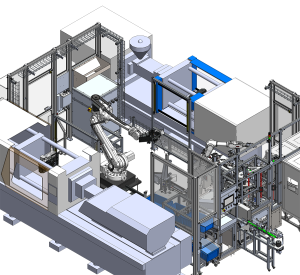
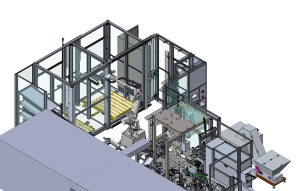
For practical purposes, let us consider a horizontal plastic injection molding machine that was put into service approximately a decade ago.
In this scenario, the factory intends to eliminate manual part removal and integrate a six-axis articulated robot for demolding and palletizing.
The modified configuration must be assessed taking into account the safety standards applicable to the new design.
Let us consider two scenarios and assess how they differ in terms of the type of modification they represent.
Scenario 1: Compatible Integration
Engineering solution: The injection molding machine has a standard interface (e.g., Euromap 67). The robot operates within a perimeter-guarded cell, with the interfaces and safety functions coordinated with the injection molding machine through signals provided by the manufacturer.
Analysis Result: Low likelihood of constituting a substantial modification. For this to be the case, the integration must comply with the conditions specified by the manufacturer, and the risk assessment must demonstrate that the remaining elements of the regulatory definition are not met. The integrated cell must nevertheless undergo the corresponding risk assessment and conformity assessment process.
Scenario 2: Unforeseen Modification
Analysis Result: The injection molding machine does not have an interface intended for this integration. The original protective door in the mold area is removed, and a safety scanner is introduced, requiring changes to the architecture and logic of the safety functions originally specified by the manufacturer.
Resultado da Análise: High potential for classification as a substantial modification. The removal of the original protective measures, the creation of new hazards, and the modification of the safety-related control system require a formal assessment. If the elements of the regulatory definition are confirmed, the entity responsible for the modification will be considered the manufacturer with respect to the affected equipment.
Technical Decision-Making Methodology
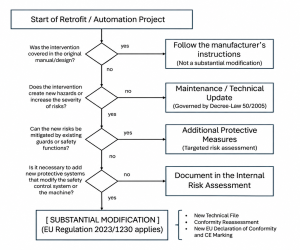
Before starting any modernization or automation project, the engineering team should follow a decision tree based on objective criteria.
This methodology is illustrated in the image below:
Preliminary Checklist
Before commissioning work or awarding a contract for robotic integration projects, those responsible for engineering should consider and validate the following conditions:
- Available Documentation: Are the original EC/EU Declaration, instruction manual, updated schematics, information on safety functions, and records of previous modifications available?
- Manufacturer Provisions: Are communication interfaces or manufacturer application notes available for connecting peripheral equipment?
- SRP/CS Integrity: After the modification, do the affected safety functions continue to meet the applicable Category and PLr?
- Kinematics and End-Effector: Does the gripper introduce independent hazards, such as shearing or loss of vacuum resulting in hot parts falling, in the surrounding area?
- Guards and Access: Have guards, access points, safety distances, and protective devices been reassessed in accordance with the standards applicable to the new configuration?
- Logical Access Security: Does the communication architecture comply with the industrial cybersecurity and robustness principles of IEC 62443?
- Contractual Responsibility: Does the technical specification clearly define the scope of each party, the interfaces included, the documentation to be produced, and the applicable regulatory obligations?
The Role of Specialized Engineering
Regulation (EU) 2023/1230 is not intended to prevent the modernization of existing machinery. On the contrary, it provides clear boundaries to ensure that productivity gains from robotics and advanced automation do not result in new risks to operators or equipment non-compliance.
At Selmatron, we analyze integration and modernization projects from the design stage onward, considering the impact of modifications on risk assessment, safety functions, interfaces between equipment, and the associated technical documentation.
This approach makes it possible to address engineering decisions and the corresponding conformity framework as parts of the same process, reducing the risk of identifying critical modifications only in the final stages of the project.
Are You Planning a Retrofit or Modification to Existing Machinery?
Before starting the work, it is important to assess the impact of the modifications on risks, safety functions, and the equipment’s conformity framework.
An analysis carried out during the engineering stage makes it possible to define the scope of the work and the required documentation in advance.
To make modifications to industrial machinery and successfully carry out retrofit projects, select the right industrial automation partner for your company.
Contact us to find out how we can help.
References
Inc, iTeh. «EN ISO 13857:2019 – Safety Distances to Prevent Limb Hazards Machinery». iTeh Standards. https://standards.iteh.ai/catalog/standards/cen/b3ceb94f-f937-4968-95fd-2aaaacb2c871/en-iso-13857-2019 (1 de novembro de 2026).
International Electrotechnical Commission. 2018. «Security for Industrial Automation and Control Systems – Part 4-1: Secure Product Development Lifecycle Requirements». https://www.iec.ch (30 de outubro de 2026).
International Electrotechnical Commission. 2019. «Security for Industrial Automation and Control Systems – Part 4-2: Technical Security Requirements for IACS Components». https://www.iec.ch (30 de outubro de 2026).
ISO. 2012. «Safety of Machinery — Safety-Related Parts of Control Systems — Part 2: Validation». https://www.iso.org (30 de outubro de 2026).
ISO. 2015. «Safety of Machinery — Guards — General Requirements for the Design and Construction of Fixed and Movable Guards». https://www.iso.org (30 de outubro de 2026).
ISO. 2023. «Safety of Machinery — Safety-Related Parts of Control Systems — Part 1: General Principles for Design». https://www.iso.org (30 de outubro de 2026).
Ministério das Actividades Económicas e do Trabalho. 2005. «Decreto-Lei n.o 50/2005, de 25 de fevereiro | DR». DL 50/2005. (2005). https://diariodarepublica.pt/dr/detalhe/decreto-lei/50-2005-584397 (30 de outubro de 2026).
Regulamento (UE) 2023/1230 do Parlamento Europeu e do Conselho, de 14 de junho de 2023, relativo às máquinas e que revoga a Diretiva 2006/42/CE do Parlamento Europeu e do Conselho e a Diretiva 73/361/CEE do Conselho (Texto relevante para efeitos do EEE). 2023. 165 OJ L http://data.europa.eu/eli/reg/2023/1230/oj (30 de outubro de 2026).
"*" indicates required fields